%20(1920%20x%201080%20px)(2).png)
.png)
.png)
Readybotz AI Competition
Drone - Drone Obstacles (Manual)
Age Category
Junior Primary (7 to 9 years old)
High Primary (10 to 12 years old)
Secondary (13 to 15 years old )
Senior Youth (16 to 19 years old)
Adults (20 years old and above)
1. Competition Objective
The objective of the competition is to skillfully deploy and operate a drone through an obstacle course. Victory is achieved by completing the course in the shortest amount of time.
Key objectives include:
-
Obstacles Objectives: The primary goal is to complete the whole course by going through all the obstacles.
-
Win on Speed: The team that completes the objectives in the shortest time will be declared the winner.
2. Competition Arena
The venue is a 400cm long, 300cm wide, a 3D and a 2D representation is shown below:
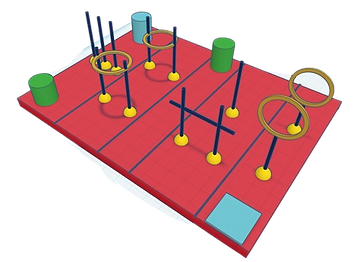

Size 3m * 4m
-
The take-off area is approximately 60cm X 30cm. Drones must take off from this area (Refer to “Start” Box above).
-
Obstacles
-
(1st set Hoop 1-2): The height of the high hoop is approximately 80cm above the ground, the low hoop is 20cm above the ground, and the hoop diameter is 40 cm.
-
(2st set Pole 1-2): A pole and a horizontal pole
-
(3rd set Hoop 3-4): Hoops that are facing up, where both hoops have the height of approximately 80cm, and the hoop diameter is 40 cm.
-
(4th set Pole 3): 3 Poles placed right in the middle of the final part
-
-
Landing Points/ CheckPoints: There are 2 checkpoints and 1 final landing point in the map.
-
Checkpoint 1: Middle of the map, able to land on base
-
Checkpoint 2: Final part of the map, able to land on base
-
Final Landing: Final part of the map, able to land on base
-
-
The obstacle areas is approximately 300cm X 87.5cm
-
The middle area is approximately 300cmX40cm
3. Drone Parameter
-
Drones are quadcopters with no more than 20cm inclusive of propeller protectors. The flying weight must not exceed 200g (including battery).
-
The nominal voltage of the power battery must not exceed 4.2V, and the capacity must not exceed 1100mA.
-
Drones are operated by radio remote control.
-
All drones must support infrared transmitting functions.
4. Competition Teams
-
There will only be 1 contestant for a team.
-
Every contestant is allowed to carry one drone.
5. Competition Rules and Procedures
-
During the competition, fallen drones can re-fly to continue the game. If they cannot re-fly, the corresponding participating team can use the right to replace a spare drone only once per game. If the spare drone falls again and cannot re-fly, they must wait for the end of the current game.
-
Each match only has 1 round, lasting only a maximum of 3 minutes. The clock will not stop during a single round except for pauses announced by the referee.
-
Checkpoints
- If the drone has fallen or been knocked down, the drone must be placed back to the checkpoint to start again. There is no penalties for restarts.
- A checkpoint is only counted if the drone lands securely. If the drone touches the checkpoint but then tips over, the attempt is invalid and no time will be recorded.
- Drones must land on every checkpoint to complete the course. Skipping checkpoints are prohibited
- A drone must complete all the obstacles before the checkpoints, skipping any obstacles are prohibited.
- If a drone restarts from a checkpoint, it must re-attempt all obstacles that follow, even if they were completed before the restart.
- If a drone falls, the referee will be responsible for retrieving the drone, the contestants are not allowed on the map. The competition timer will not pause during the retrieval
4. Tasks
All obstacles in the map must be completed sequentially (Must complete the first before the next - refer to the layout diagram and the video above) in order for the time to be recorded. Skipping any obstacles is not allowed in this competition.
The Course:
Part 1: First the drone must fly through the 2 hoops positioned in the first stage.
The drone must pass through the first hoop closest to the starting point first,
then proceed to the next lower hoop
Part 2: After navigating the first half, the drone will enter the second stage and must perform the following maneuvers in order:
-
Execute one complete horizontal loop around the vertical bar.
-
Proceed to the final horizontal pole and complete one full vertical loop around it
Part 3/Checkpoint: After going through the 2nd stage, the drone can proceed into the 3rd stage, where a landing point/checkpoint is placed. The drone must land on the checkpoint as part of the course.
Part 4: The drone must fly into the 4th stage from the landing point. There will be 2 hoops that the holes are facing upwards. The drone must fly upward through the first hoop, then fly downward through the second.
3D Representation:
Part 5/Final Part: After completing the 4th stage, the drone will have to fly in and land on the second landing point/checkpoint that is positioned. The drone must then take off to complete the final obstacle that consists of 3 poles, and the drone is required to loop around each and every pole shown below. The drone can start from any side, with the condition that the drone must finally loop around each and every pole.
Example on how the drone can complete the task
5. Scoring Rules (Refer to the score sheet in the final page)
-
The drone MUST go through all the obstacles for the time to be taken. Different times will be taken for the following:
-
The first checkpoint
-
The second checkpoint
-
The final landing point
-
-
Winner will be decided with the fastest time of completion
In the event of a tie in the final course time, the following procedure will be used to determine the winner:
-
First, the times at Checkpoint 2 will be compared. The contestant with the faster time wins.
-
If the times at Checkpoint 2 are also tied, the times at Checkpoint 1 will be compared to determine the winner.
6. The following situations are considered serious violations, resulting in an immediate loss and settlement of the current scores of a contestant:
(1) Using equipment or devices that do not follow competition rules or have not been approved by the referee.
(2) Unauthorizedly turning on or using wireless equipment during the competition by a non-competing team.
(3) Disobeying commands and causing consequences.
(4) Using methods of bribery in order to achieve better results
OBJECTIONS
-
Referee decisions are not subject to teams' objections. In case of disagreements or opposing opinions, the referees have the final say in cooperation with the Headjudges and the Organizing Committee.
-
In the event that a specific competition category or round is conducted over multiple days or involves multiple attempts, the Organizer reserves the absolute right to determine the most appropriate scoring methodology to identify the winner(s).
-
Should there be any grievances, participants are directed to: contact@bestemready.com or Whatsapp at 012-391 8681


